Cygames' Pretty Derby (hereafter referred to as Pretty Derby), launched in February 2021, quickly became a phenomenon in the Japanese and global mobile gaming markets. Meanwhile, Konami, a veteran in Japan's gaming industry, not only holds globally renowned IPs like Metal Gear and Silent Hill but also possesses decades of R&D experience and extensive patent accumulation in sports simulation and dating simulation games, particularly its Power Pros series and Tokimeki Memorial series.
In March 2023, Konami formally filed a lawsuit with the Tokyo District Court, alleging that Pretty Derby infringed upon its patents. This legal dispute lasted approximately 20 months before concluding in November 2025 with both parties reaching an “amicable settlement.” The core of this lawsuit did not revolve around plagiarism of character designs or art styles, but directly targeted patents for the “game systems and programs” at the heart of gameplay mechanics. This case was not merely a commercial dispute involving claims of 4 billion yen, but evolved into a prototypical legal battle over whether “game mechanics can be monopolized by patents” and how large corporations employ “patent deterrence and countermeasures.”
 PART 1
Litigation Initiated:KONAMI's ¥4 Billion Claim and Injunction Request
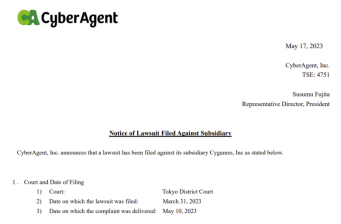
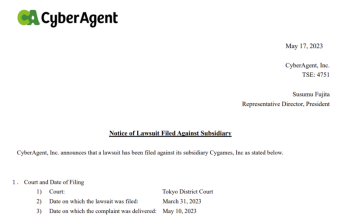
Although Konami's lawsuit was filed with the Tokyo District Court on March 31, 2023, this information only became public in May 2023. The complaint was formally served to Cygames on May 10, 2023. On May 17, 2023, Cygames' parent company CyberAgent, Inc. released an Investor Relations (IR) document titled “Notice of Lawsuit Filed Against Subsidiary,” formally disclosing this significant litigation to the public and market for the first time.
 According to CyberAgent's official announcement, Konami raised two core legal claims in its complaint:
1. Damages: Konami demanded Cygames pay 4 billion yen (approximately $29 million at the exchange rate at the time, later reported estimates put it at $26 million), plus corresponding delay damages.
2. Injunction Request: Konami seeks a court order compelling Cygames to cease the “production, use, and provision via telecommunications lines” of the game Umamusume.
Should the court grant this injunction, it would spell catastrophic consequences for Umamusume—Cygames' flagship title—potentially forcing its shutdown. Konami's true objective likely isn't to commercially “strangle” Umamusume (which could provoke significant backlash from the industry and players). Instead, it aims to exert maximum legal pressure to force Cygames back to the negotiating table and accept Konami's licensing terms. This represents a classic “force a settlement through litigation” strategy.
Prior to the lawsuit, Cygames and Konami had engaged in prolonged “discussions” regarding “patent rights for certain aspects of the game system and programming” in Umamusume. However, negotiations ultimately broke down. Konami likely first demanded patent licensing from Cygames (i.e., payment of royalties), but Cygames refused based on legal or commercial judgments (e.g., believing it did not infringe, or that Konami's patents were invalid). After negotiations failed, Konami, as the patent holder, initiated litigation as a necessary escalation to protect its rights and exert pressure.
PART 2
Controversial Focus:
The 18 Patents Allegedly Infringed and the “Training System”
Konami explicitly states in the lawsuit that the game systems and programs of “Umamusume” infringe upon as many as 18 patents it holds. Although neither party has disclosed the complete list or specific details of these 18 patents, all public reports and industry analyses consistently point to the signature core gameplay of ‘Umamusume’—the “Training System.” Industry consensus suggests these patents are closely related to Konami's flagship IPs: the “Success Mode” from the Pro Baseball Power series and the character cultivation systems in the Tokimeki Memorial series. Multiple public reports also identify a key patent as Japanese Patent No. 5814300 (Patent Title: “Game Management Device and Program”). Claim 1 of this patent describes a game management device and its program, whose core mechanism comprises two key components:
1. Setting Means: Allows users to select at least one character from their roster as the “First Character for Event Generation” (イベント発生用の第1キャラクタ).
2. Event Management Means: The device possesses a function to generate “specific events” (特定のイベント) within the game based on the “First Character” set by the preceding “Setting Means,” or combinations of multiple “First Characters.”
Comparing this patent claim with the actual gameplay mechanics of “Umamusume,” Konami's logic for infringement allegations becomes apparent. The core of Umamusume's “training” mode involves players selecting and configuring a set of “support cards” from their card pool when beginning to train a specific Umamusume. This precisely matches the “setting means” described in Patent 5814300—selecting and setting the “first character” from owned characters. The specific combinations of “support cards” configured by players can (based on probability) trigger specific random events, exclusive dialogue sequences, provide different training bonuses, or directly grant the character new skills. This precisely corresponds to the patent's “event management means”—generating specific events within the game based on the configured “Primary Character” combination. Thus, Konami's core argument asserts that the underlying program architecture and event-triggering logic of Cygames' “Support Card System” in Umamusume replicates Konami's patented “Event Management System.”
As a direct countermeasure to Konami's lawsuit, Cygames announced it has filed “invalidation trial requests” (無効審判を請求) with the Japan Patent Office (JPO) targeting all 18 patents cited in Konami's lawsuit. Cygames' intent with this move is to demonstrate to the court and Konami that these 18 patents (including the pivotal Patent No. 5814300) may have lacked novelty or inventive step at the time of application.
Although the case ultimately concluded with a confidential settlement, preventing substantive rulings from the court and the Patent Office, the dispute left publicly accessible records within the judicial and administrative systems throughout its 20-month duration.
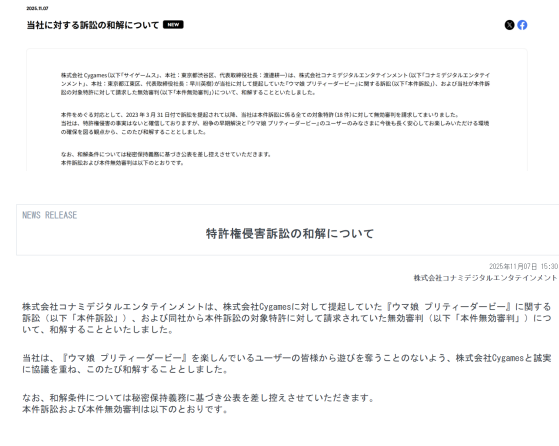
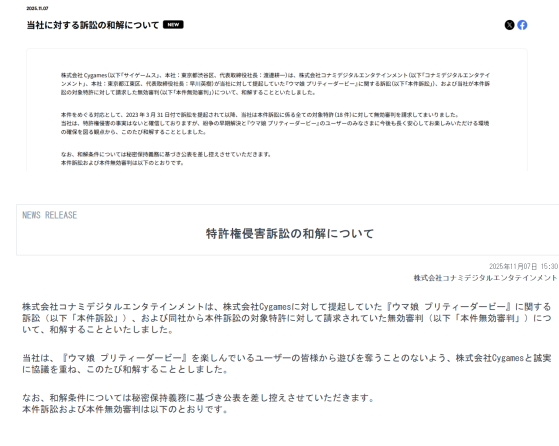
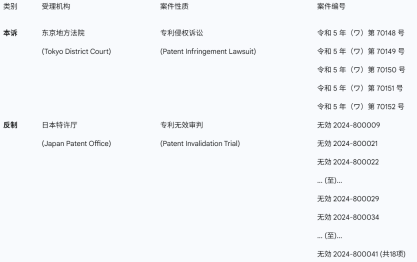
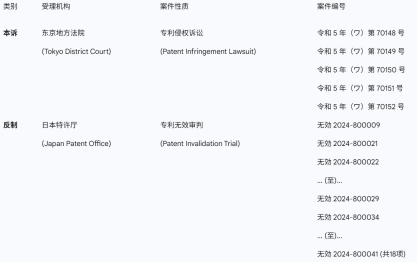 On November 7, 2025, Cygames and its parent company CyberAgent, along with Konami, each issued announcements declaring that the parties had reached an “amicable settlement” regarding the patent infringement lawsuit over “Umamusume” and related invalidation trial requests. Under the settlement agreement, all legal actions by both parties were simultaneously terminated: Konami withdrew all five lawsuits filed in the Tokyo District Court; in response, Cygames also withdrew all 18 patent invalidation requests filed with the Japan Patent Office. Both parties explicitly emphasized in their announcements that, pursuant to the “confidentiality obligations” signed by both sides, the specific terms of the settlement—particularly any potential financial terms such as settlement amounts or licensing fees—would not be disclosed.
 PART 3
An Unresolved Legal Question
As the case ultimately concluded with a confidential settlement, Konami withdrew its lawsuit and Cygames withdrew its request for invalidation. This means the Tokyo District Court and the Japan Patent Office never issued a public substantive ruling on the core legal dispute in this case:
1. Are Konami's patents related to “development systems” (e.g., Patent No. 5814300) truly valid? Can they withstand challenges for invalidation?
2. Does the “support card” system in Umamusume constitute legal infringement of the aforementioned patents?
This unresolved legal issue means Konami's 18 patents retain significant legal deterrence within Japan's gaming industry.
1. The Shadow of “Game Mechanics” Patents: The emergence and resolution of this case underscores an industry-wide reality: “game mechanics” (or more precisely, the systems, program architectures, and algorithms implementing specific game mechanics) can be patented and leveraged by patent holders to initiate costly litigation.
2. Chilling Effect: Konami's patent portfolio has emerged from this battle with its deterrent power not diminished, but amplified. Moving forward, other game developers—regardless of size—will need to assess the legal risks posed by Konami's patent portfolio before designing any similar systems involving “character progression” or “support cards triggering random events.” This could stifle gameplay innovation or, more likely, compel newcomers to proactively seek patent licenses from Konami, thereby further cementing Konami's market dominance in specific game mechanics domains.
 PART 1
 根据CyberAgent的官方公告,Konami在诉状中提出了两项核心法律主张 :
  2025年11月7日,Cygames及其母公司CyberAgent与Konami 分别发布公告,宣布双方已就《赛马娘》专利侵权诉讼及相关的无效审判请求,达成了“友好和解”。 根据和解协议,双方的法律行动同时终止:Konami撤回了在东京地方法院的全部5项诉讼;作为回应,Cygames也撤回了向日本特许厅提起的全部18项专利无效审判请求。双方均在公告中明确强调,根据双方签署的“保密义务”,和解的具体条款(尤其是任何潜在的财务条款,如和解金额或许可费用)将不会被披露。